
How Canyoning Builds Team Trust Under Pressure

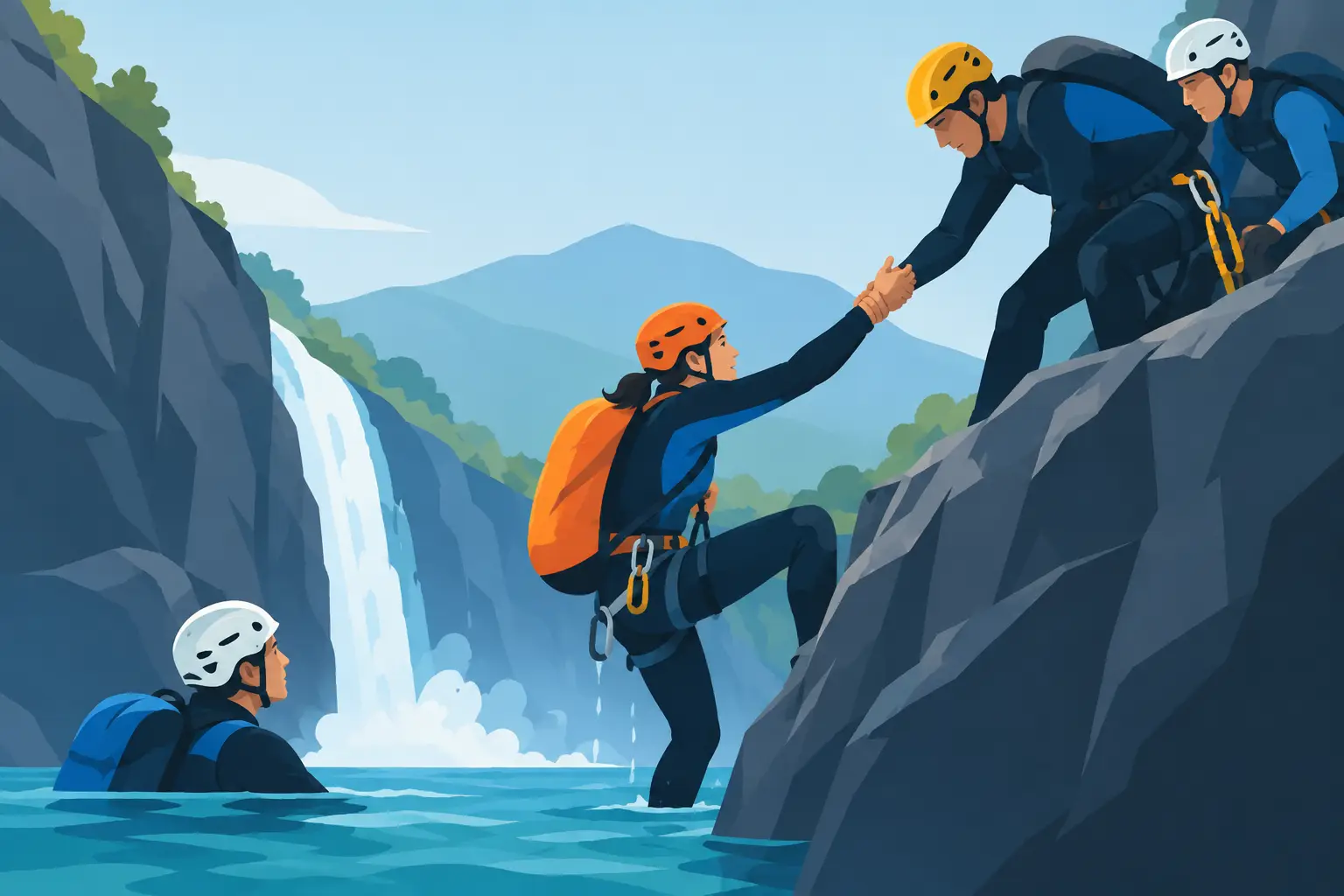
A rope goes taut at the top of a waterfall. One person is clipped in, looking down. The rest of the group are close by – checking the plan, calling encouragement and waiting for their turn. That is how canyoning builds team trust: not through forced icebreakers or a slide deck about collaboration, but through a real challenge where people need to communicate, listen and back each other.
For corporate teams, friend groups and organised groups, canyoning creates a powerful change of scene. Away from desks, meeting rooms and familiar roles, everyone is faced with the same wet rocks, narrow gorges, cool pools and big moments. It is exciting, properly memorable and far more revealing than a standard team day.
Trust starts when everyone has a role
A canyon is not a place for spectators. Even when one person is on the rope, the team around them matters. People pass equipment, listen to guide instructions, help keep the group moving and make space for the next person to focus.
That shared responsibility changes the dynamic quickly. The loudest person in the office is not automatically the most confident at a waterfall. A quieter colleague might be calm, observant and brilliant at reassuring someone before an abseil. Canyoning gives people a chance to contribute in ways that are not always visible during the working week.
The result is not simply that colleagues get to know one another better. They see evidence of each other’s character: who stays composed, who notices when someone needs support, who asks sensible questions and who can make the group laugh when nerves are building.
Shared challenge creates genuine connection
Trust is hard to manufacture. Teams usually build it after navigating something that feels meaningful together. In canyoning, that might be stepping backwards over the edge of an abseil, making a jump into a deep pool, squeezing through a rocky section or walking beneath a waterfall in the Waitākere rainforest.
Nobody has to pretend these moments are routine. A little nervous energy is part of the adventure. What matters is what happens next. The group watches a teammate receive training, follow the system and complete the challenge. Then they have their own turn, with the same people beside them.
That sequence builds a useful kind of trust. You learn that your colleagues will not dismiss your nerves, rush your decision or leave you to work things out alone. You also learn that encouragement works best when it is specific and honest. “Take your time, you’ve got this” lands differently when everyone can see the water below and knows what the moment feels like.
It is challenge with support, not pressure for pressure’s sake
Good team trust does not come from throwing people into the deep end. It comes from a well-managed challenge with clear choices, professional guidance and enough support for people to stretch their comfort zone safely.
That is why guided canyoning works for mixed groups. Participants are trained before they tackle the technical sections, essential equipment is provided and guides explain what is happening at each stage. No previous canyoning experience is needed, but a willingness to get wet, move through uneven terrain and give something new a go certainly helps.
The challenge can also be matched to the group. A half-day trip may suit a team looking for a high-energy introduction, while a full-day adventure offers more time for major abseils, waterfalls, caves and the satisfying feeling of earning every finish-line grin. For groups after a different rhythm, a night canyoning experience adds glowworms and rainforest darkness to the mix. The best option depends on fitness, confidence, time available and what the group wants to take away from the day.
Clear communication becomes non-negotiable
In the canyon, vague communication is not much use. Instructions need to be heard, understood and acted on. Team members naturally start using clearer language: “Rope clear”, “I’m ready”, “Can you help with this?”, “Take a moment.”
That clarity is one of the most useful habits a group can bring back with them. In a workplace, people often assume others have the same information or know what is expected. In a canyon, assumptions slow things down. The group learns to check, confirm and speak up early.
There is also a strong lesson in active listening. A guide may be explaining how to position your body for an abseil while water is roaring nearby. Paying attention is not optional. Participants see how much easier a challenge becomes when everyone stops, listens and follows an agreed process.
For teams that struggle with crossed wires or people talking past one another, this is a refreshing reset. The environment is fun, but the communication is real.
People learn to ask for help without losing face
Most teams say they want openness. In practice, people can still worry that asking for help will make them look inexperienced or incapable. Canyoning breaks that pattern fast.
A participant might need a hand finding stable footing, want an instruction repeated or decide they need another minute before committing to a jump. Asking is sensible, not a weakness. The group sees that confidence is not about acting fearless. It is about assessing the situation, using the support available and making a good decision.
This matters especially for teams with different levels of experience. Outdoor regulars and first-timers can both have great days, provided the group respects different starting points. The person who races ahead is not necessarily helping. The person who checks in, shares the load and brings others with them is often the person the team remembers.
A shared story lasts longer than a team-building exercise
Months after a canyoning day, people may not remember every detail of a workshop. They will remember the huge waterfall, the first step over the edge, the cold splash, the glowworms or the teammate whose face said “absolutely not” before they nailed it.
Those stories have value. They give a team shared reference points that are positive, funny and earned together. A group that has encouraged each other through a dramatic rainforest gorge has a little more social capital when work gets busy or a difficult project lands.
For visiting teams, the setting adds another layer. Auckland is close, but the Piha rainforest feels a long way from the usual routine. The contrast makes the day feel like an event rather than a compulsory off-site. It also means people leave with proper photographs, muddy shoes and a story worth retelling.
How to make a canyoning team day work
The experience works best when leaders set the tone before anyone reaches the canyon. Frame the day as an adventure, not a test of bravery or fitness. Make it clear that people are expected to support one another, ask questions and follow guide instruction.
Avoid turning every activity into a competition. A little friendly banter is part of the fun, but trust grows when people feel safe to go at their own pace. If your group includes complete beginners, choose a trip that gives them the right balance of challenge and confidence-building. If you have a highly active group hungry for Auckland’s biggest abseils, a more demanding full-day option may be the better fit.
It also helps to leave room afterwards for the group to talk. The best conversations often happen over the journey back or while swapping photos: who surprised themselves, what felt hardest and what support made the difference. That is where the lessons become personal rather than corporate jargon.
AWOL Canyoning Adventures brings the gear, training and experienced guides so groups can focus on the good stuff: moving through spectacular rainforest, taking on a serious challenge and cheering each other all the way through.
A team does not need to become a group of outdoor experts to earn trust. It just needs one shared moment where people choose to listen, step up and make sure nobody faces the waterfall alone.