Canyoning or Rafting for Your Next Big Day Out

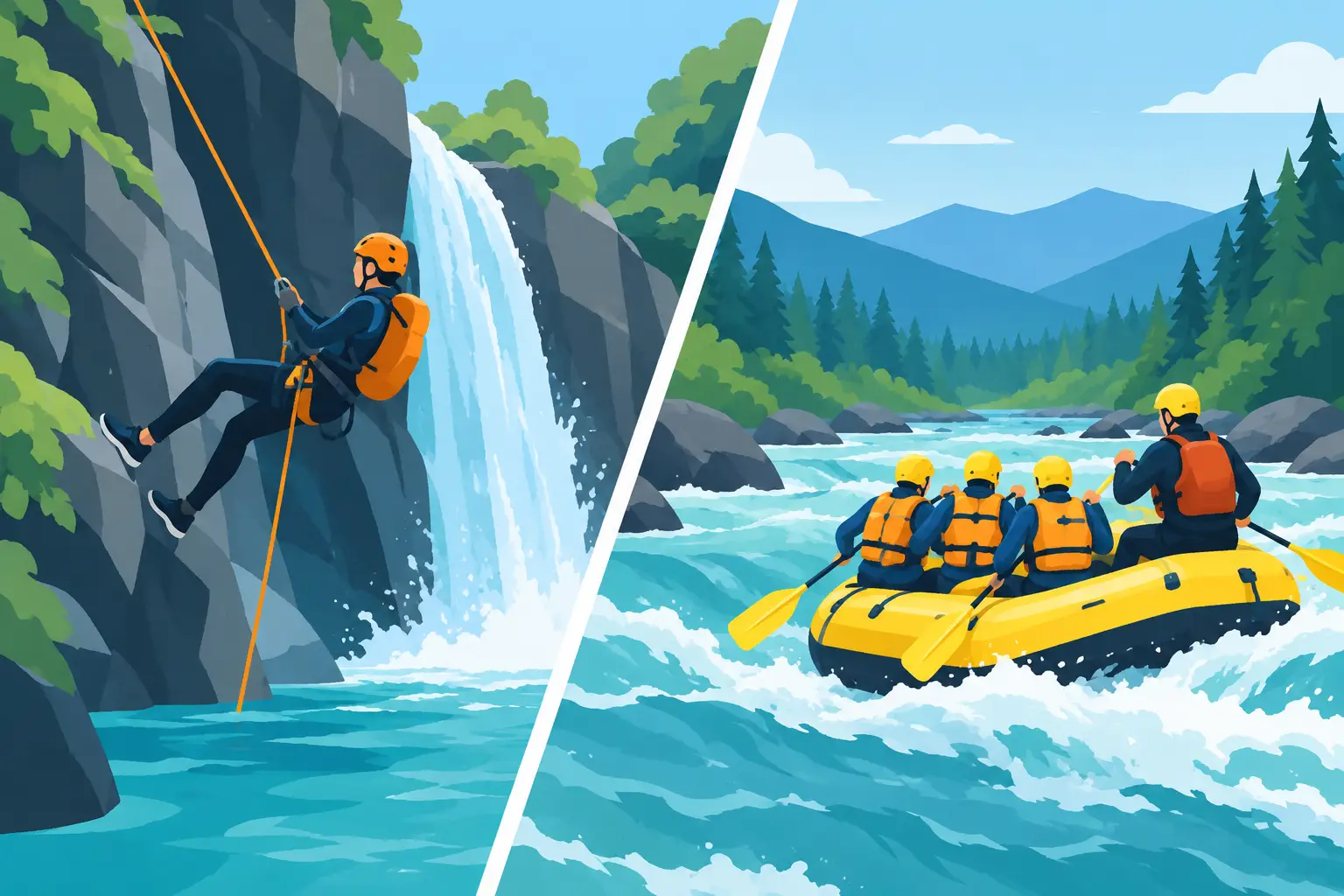
You are standing at the edge of a waterfall, clipped into a rope, with a rainforest gorge opening below your boots. Or you are in a raft, paddle in hand, charging towards a run of white water with your crew shouting behind you. Choosing canyoning or rafting is not simply about picking a wet adventure. It is about deciding how you want to take on the outdoors.
Both deliver big laughs, cold water, proper scenery and the kind of shared challenge that turns into stories for years. But they feel completely different once you are in the action. One takes you through the landscape. The other sends you down it.
Canyoning or rafting: the quick answer
Choose canyoning if you want a hands-on, all-in adventure where the route includes abseils, waterfalls, jumps, natural pools, narrow gorges and rocky stream beds. It suits people who want to get close to the landscape and tackle a fresh challenge at every turn.
Choose rafting if the main draw is fast-moving water, paddling as a team and the rush of running rapids. It is a brilliant choice for groups who want a high-energy ride with fewer technical obstacles between them and the next burst of white water.
Neither is automatically harder, wetter or more adventurous. The answer depends on the trip, water levels, weather, your group and what gets you fired up. A gentle family rafting trip is a very different beast from a steep river run, just as an introductory canyon is a different day out from a full-on route with major abseils.
What canyoning feels like
Canyoning is a moving puzzle through a wild place. You might start with a bush walk, pull on a wetsuit and helmet, then learn the basics from your guides before following the water upstream or downstream through the gorge. There is no sitting back and watching the scenery roll by. You are in it – scrambling over rocks, floating through pools, lowering yourself beside waterfalls and stepping into places that are normally hidden from view.
The standout moment for many first-timers is the first abseil. It can look enormous from the top, especially when water is pouring past your shoulder. Then the rope takes your weight, your guide talks you through the movement, and confidence clicks into place. By the bottom, you have done something that may have felt miles outside your comfort zone ten minutes earlier.
That confidence-building side is a big reason canyoning works so well for mixed groups. You do not need previous experience, your own technical kit or a background in climbing. A professionally guided trip supplies the specialist equipment and teaches you what you need before each feature. The challenge is real, but it is broken into manageable moments.
In the Waitākere Ranges near Piha, canyoning also brings the full rainforest atmosphere: dark rock walls, lush native bush, clear water, caves and waterfalls tucked away from the road. You are not just visiting the view. You are travelling through the middle of it.
Canyoning is best for people who want variety
If you get restless doing one activity for too long, canyoning has an edge. The day changes constantly. One section might involve an abseil; the next may be a swim, a short jump, a scramble or a walk through a narrow gorge. It keeps groups talking, laughing and encouraging one another.
It is also ideal for anyone who wants that big personal-win feeling. A successful descent down a waterfall is not just exciting for the photo. It is a genuine achievement, particularly if heights are not normally your thing.
What rafting feels like
Rafting is about momentum. Once the raft is on the river, the current becomes part of the group. You paddle together, listen for instructions, brace when needed and work as a crew to line up the next rapid.
The excitement often arrives in sharp, noisy bursts. The river gathers speed, the raft drops into a wave train and suddenly everyone is paddling hard while water flies over the tubes. There is a strong team element to it: when the raft moves well, it is because the group has worked together.
That makes rafting a natural option for larger parties, workplace groups and mates who want a shared mission without everyone taking on individual rope work. You still need to listen, contribute and be ready for surprises, but the central skill is collective rather than personal.
Rafting can offer quieter stretches too. Between rapids, there is often time to look around, catch your breath and enjoy the river valley. The balance between calm water and action depends heavily on the river and trip grade, so check exactly what sort of rafting experience you are booking.
Rafting is best for team rhythm and river speed
If your favourite part of an adventure is the build-up before the rush, rafting delivers. You can see the water ahead, hear it getting louder and feel the group lock in as the guide calls the next move.
It may feel more accessible to someone nervous about heights, although it is not automatically the softer option. Stronger rapids can be physically demanding, and being comfortable in moving water matters. A reputable operator will explain the requirements clearly and provide the safety briefing and gear needed for the conditions.
Compare the real trade-offs
The biggest difference is how you move. In rafting, you travel with the river in a boat. In canyoning, you travel through the river corridor on foot, by rope and in the water. That changes everything from the pace to the photos.
Canyoning usually asks for more individual movement. Expect uneven ground, climbing over rocks, walking in water and using your legs during abseils. You do not need to be an elite athlete, but you should be happy being active for several hours and willing to give new things a go.
Rafting can be less footwork-heavy, but paddling is still physical. Your upper body and core will get involved, especially on a lively river. It can also be a better fit for a group that wants to stay together in one craft rather than spread along a canyon feature by feature.
There is a different kind of exposure, too. Canyoning puts heights front and centre. Rafting puts moving water front and centre. If the thought of standing at the top of a waterfall makes your stomach flip in a good way, get into a harness. If the sound of a rapid makes you grin, grab a paddle.
How to choose for your group
Start with the person in the group who is least certain. Not because they should make every decision, but because the best adventure is one where everyone feels challenged without being pushed beyond a sensible limit.
For a stag or hen group, canyoning often wins when you want plenty of individual action, huge scenery and a day that feels miles away from the usual plan. For a corporate team, either can work well: rafting puts teamwork front and centre, while canyoning creates shared encouragement and memorable personal victories.
For visitors with limited time in Auckland, canyoning offers something particularly distinctive: a proper rainforest adventure close to the city. AWOL Canyoning Adventures runs guided trips designed to take newcomers from nervous excitement to full canyon mode, with equipment, training and optional city-centre transport sorted.
If you are choosing for a family or a group with mixed fitness levels, look closely at the specific trip rather than the activity name alone. Ask about minimum age, swimming confidence, walking time, abseil heights, water temperature and how strenuous the day is likely to be. A good operator will give you a straight answer, not a vague promise.
What to wear and what not to overthink
For either activity, the operator normally provides the technical safety kit appropriate to the trip. You will usually need swimwear and a towel, plus a sense of humour when the water is colder than expected. Canyoning providers may also provide wetsuits, helmets, harnesses and canyon footwear; rafting trips commonly include wetsuits or splash gear, buoyancy aids and helmets where required.
Leave jewellery and valuables behind, and listen properly during the briefing. That is not the dull bit before the fun starts. It is what gives you the freedom to enjoy the fun once you are in the gorge or on the river.
Make the call
Pick rafting for the buzz of white water, paddles and group rhythm. Pick canyoning for a wilder, more varied journey through waterfalls and rainforest, where every obstacle becomes part of the adventure.
If you are still torn, choose the experience that makes you slightly nervous in the best possible way. That is usually where the best stories begin.